A sour smell that comes and goes, gets worse at night, and seems to move around the house is one of the more maddening problems to live with. You start doubting whether you can smell it at all. We deal with it every week across Wandong, and it is almost always exactly what you think it is.
Dead rodent work is different to every other carcass job because of numbers. A house mouse weighs around twenty grams, so a single animal produces a smell that is noticeable but survivable, and it clears in a week or two. The problem is that mice are colonial and habitual. They use set runs behind kickboards, up wall cavities, along rafters and around pipe penetrations, and where one dies others usually have too. It is entirely normal to find three or four carcasses in different cavities on the one job. If you are not certain what you are dealing with yet, our guide to identifying what died in your property runs through the same signs we work from.
That is why finding one animal and calling it done is the most common mistake in this work. The strongest odour point gets opened up, a mouse comes out, and a fortnight later the customer is back on the phone because the smell has apparently moved two metres down the wall. It has not moved. There was a second carcass there the whole time. Our technicians work the full run rather than the single hotspot, which is the reason the smell actually stops. That half-finished version of the job is why the dead animal smell comes back after DIY removal, almost always because something was left behind.
The other half of a rodent job is everything the colony left behind while it was alive. Mice urinate almost continuously as they travel, and droppings build up along the run in the same places year after year. That dried material carries salmonella and leptospira organisms, and disturbing it puts it straight into the air of the room below. So we do not simply lift out the bodies. We treat the contaminated surfaces, remove nesting material and soaked insulation, and deodorise the cavity properly.
Tell us where the smell is worst and we will call back with a time and a quote.
Rodent contamination is quieter than a rat or possum problem, which is exactly why it gets left too long. These are the signs worth acting on before the colony turns into a full decontamination job.
Mouse odour is lighter and more sour than a rat, and it tends to fade in the morning and return by evening. That on and off pattern is what makes people doubt themselves for a week before they call.
Mice die in numbers and along the same runs, so it is common to have a smell in the pantry wall, another near a bedroom skirting and a third above the laundry. One carcass is unusual. Three or four is normal.
Because a mouse is small, you tend to get cluster flies, tiny beetles and pale larvae rather than big blowflies. They usually show up at a downlight, a power point or the gap under a kickboard.
Chewed cardboard, insulation fluff, paper and fabric packed into a corner of a cupboard or roof space means a nest, and a nest usually means more than one animal has been living and dying in that spot.
Dark rice grain droppings tracking along the back of a cupboard, a rafter or a wall plate map the run the mice were using. The carcass is almost always on or beside that line.
If the smell arrives with the ducted heating or worsens on a hot afternoon, the carcass is likely near a duct run, a hot water service or an uninsulated roof space where the temperature is driving decomposition.
Anyone can pull one mouse out of a wall. The job is finding the rest of them and cleaning up what the colony left behind, and that is what we quote as a single price.
A dead mouse odour peaks within days and can make a bedroom unusable. We answer the phone in Wandong around the clock and dispatch, rather than booking you in for next week.
Finding one carcass and leaving the rest is the most common mistake in rodent work. We search the full run, not just the strongest odour point, so the smell does not simply move down the wall.
You hear the figure before anything is opened up, and the decontamination is inside it. The number only moves if the scope genuinely changes and you agree to it first.
Rodent urine, droppings and decomposition residue all get treated, not just the body. Antimicrobial treatment and enzyme deodorising are part of every dead rodent removal we quote.
No signwriting. That matters in cafes, shops and rentals, where a branded pest van parked out front becomes a problem of its own before we have even got inside.
Crews who know how the homes around Wandong are built, from brick veneer to weatherboard to converted apartments, which means less searching and less cutting.
Three stages, in this order, every time. Nothing gets opened before you have seen the price, and nothing gets closed up before the cavity has been treated.
With rodents the search is wider than the smell. A technician maps odour intensity across every suspect wall, cupboard and ceiling area, traces the droppings and grease marks that show where the run goes, then brings in detection equipment and a pilot hole check to confirm each carcass before anything is cut.
Only once we know how many animals there are and where they sit do we talk about access and give you a fixed price. In most Wandong homes that means lifting a kickboard or opening one small panel, patched cleanly on the way out. If you want the full breakdown of how much dead animal removal costs in Melbourne, we have set out every factor that moves the number.
Every carcass, plus the nesting material and contaminated debris around it, comes out in sealed double bagged containment and leaves with us, disposed of through channels approved under Victoria environmental health requirements.
Then comes the part that actually fixes the smell. Rodent urine and droppings have been accumulating along that run for months, and the decomposition residue soaks into plasterboard, framing and insulation. We treat those surfaces with hospital grade antimicrobials, cut out and replace insulation that cannot be salvaged, and run bio-enzymatic deodorisers that digest the odour compounds instead of masking them. Where that residue has already reached the plaster, our guide to brown ceiling stains and what they mean is worth reading before you paint over anything.
A mouse fits through a gap the width of a pen, which is why rodent proofing is a detail job rather than a big one. Before we leave we walk the perimeter and the roof line and mark up the weep holes, pipe penetrations, gapped weatherboards, unsealed eaves and torn subfloor screens that let the colony in. The roof space is the hardest of those to judge from the ground, so our homeowner's guide to a dead animal in your roof explains what to look and listen for.
You get that written up with photographs and a sensible order to work through. We will not seal an active run on the same visit, because closing the hole while mice are still inside simply leaves you more carcasses in the cavity than you started with.
Most of our rodent work is ordinary homes across Wandong where mice have been living, and dying, somewhere nobody can reach. These are the spots we find them:
The kitchen is the usual starting point, because that is where the food is and the appliance cavities give mice warmth and cover. Same day attendance keeps it to one visit, and you get the room back that afternoon rather than eating around the smell for another fortnight. Those warm cavities are also why dead animal smells get worse in summer, which is why a January callout rarely waits.
Same-Day Response
Emergency crews reach Wandong homes quickly
Droppings, urine and odour all treated
No hidden fees, firm estimate before we start
A hands-on team focused on safe, thorough work
In a food business a rodent smell is a food safety problem before it is a comfort problem. We attend these sites discreetly, in unmarked vehicles, and around your trading hours where that helps:
You get the carcasses out, the run decontaminated, and a written record of what was found and what was treated. That document is what a council inspector, an auditor or a head office audit file actually wants to see, and we supply it as a matter of course.
Fast Business Response
A team handling commercial rodent recovery every week
Discreet unmarked attendance outside trading hours
Documentation for food safety and audit files
Scheduled monitoring for sites with recurring activity
With rodents the price hinges on how many animals there are and how much contamination the colony left, which is why nobody can quote it properly sight unseen. You get a firm figure on site, before anything is opened, and the clean up is inside it.
A single mouse behind a kickboard is a quick job. A nest that has been dying off inside a roof space over several weeks is a much larger clean, and the price reflects that honestly.
Behind a removable kitchen panel is easy. Inside a sealed stud bay, above a rendered ceiling, under a tight subfloor or behind a tiled splashback takes longer and needs more care to open and make good.
Business hours are the usual rate. Genuine after hours, weekend and public holiday attendance carries a call out loading, and we tell you that on the phone rather than on the invoice.
A mouse found early is contained and light. Weeks in, the fluids have wicked into plasterboard and insulation and the deodorising scope grows well beyond the carcass itself.
Lifting a kickboard costs nothing. Cutting a neat access panel in a ceiling or wall and patching it properly is real work, and where that is needed it is quoted with the job upfront.
Droppings, urine staining, contaminated insulation and nesting debris all add to the decontamination scope. A long running rodent problem is always more clean than removal.
Ring us and describe the smell and where you have noticed it. We will tell you what we think you are dealing with and what it takes to confirm it. No obligation, and no charge for the conversation.
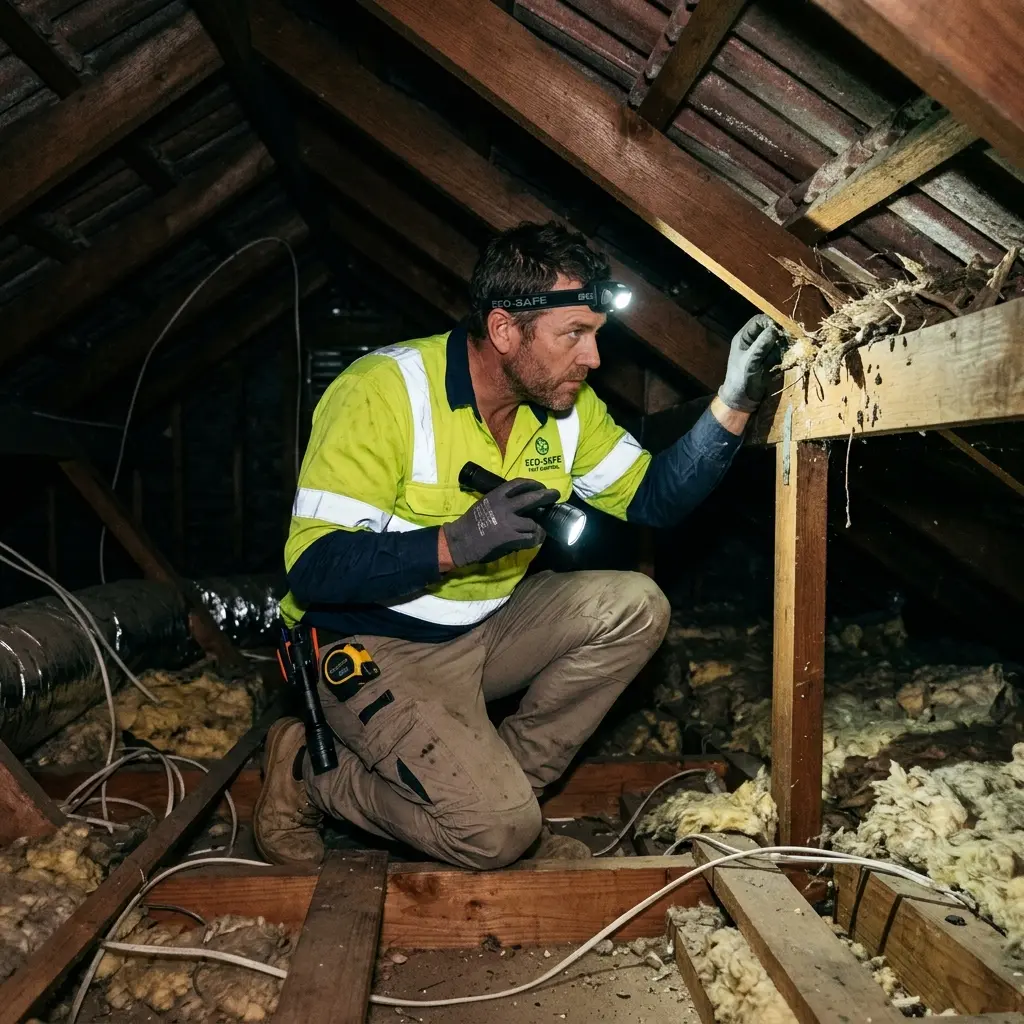
Rodent smells are easy to talk yourself out of for a week, and that week is usually when a two carcass job turns into a five carcass job. Our locally based crews hold same day inspection availability across Wandong and the surrounding suburbs, and we take emergency calls at any hour.
A technician arrives, maps the odour across the whole property rather than the one room you noticed, scans the suspect cavities and tells you how many animals you are actually dealing with. That number is often higher than people expect, and it is much better to know it before the work starts than halfway through. That whole-property sweep matters because of how fast a dead animal smell spreads through a house, and why the room you noticed first is rarely the room the animal is in.
If it turns out to be something other than rodents, we will say so. A dead rat in the wall, a possum in the roof or a drainage issue are all things we would rather identify honestly than treat as a rodent job you did not need. If what you heard sounded heavier than a mouse, rat or possum: how to tell will help you narrow it down before we arrive.
These are the calls that go to the front of the queue. If any of them describe your Wandong property, ring us rather than booking online.
We provide dead rodent removal across Wandong and every surrounding suburb, with crews based locally so less of the day is spent driving to you.
Need immediate Dead Rodent Removal? Our emergency team is available across all suburbs.
Call Emergency LineOur Wandong crew also covers the suburbs right next door, so dead rodent removal in any of these is the same short drive.
Guides & Insights
Reading That Saves You A Callout
Practical explanations of what you are smelling, what it is likely to cost and what to do first in Wandong.
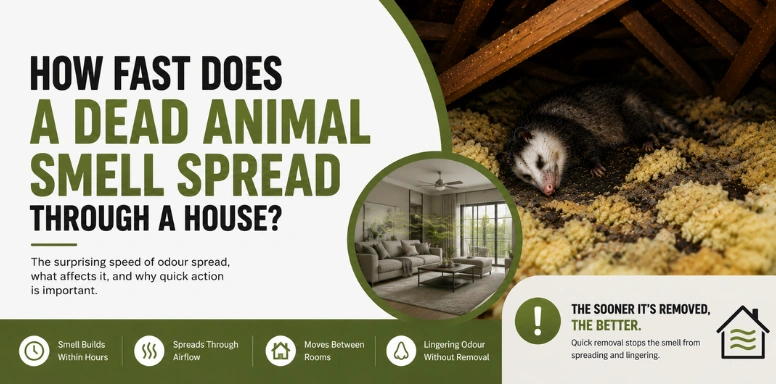
By day four it seems to be everywhere and people assume there must be more than one animal. Usually there is not. Here is how the odour actually moves.
Read the guide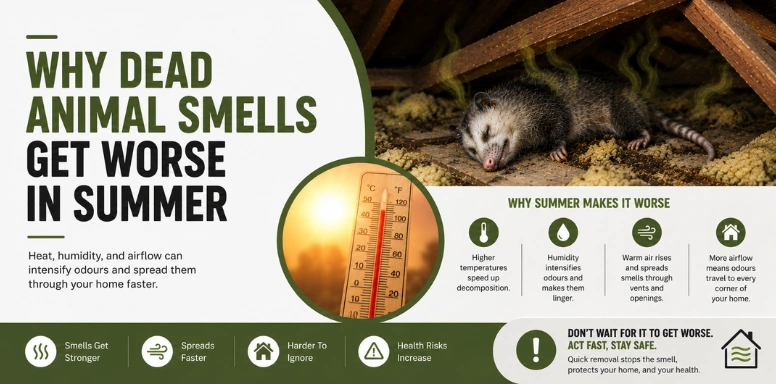
The same carcass behaves entirely differently in January than it does in July. Here is the chemistry behind it, and why summer shrinks your decision window to days.
Read the guide
Nobody can quote this properly over the phone, and anyone who does is guessing. Here are the six factors that move the number, and how to tell a fair quote from a bait price.
Read the guideThe things Wandong customers ask us before they book a dead rodent removal.
Find Them All, Or Find The Smell Again Next Week.
Rodents die in groups along shared runs, and half a job leaves you exactly where you started. One phone call gets a technician to your door with the gear to search the whole run and the chemistry to clean up after it.
6:00 AM - 11:30 PM, 7 Days a Week for Wandong, VIC 3758 and every surrounding suburb.